You are currently viewing a placeholder content from Vimeo. To access the actual content, click the button below. Please note that doing so will share data with third-party providers.
Short and Sweet
The screenplay, which accurately recaps the historical trial of Joan of Arc in Rouen in 1432, condenses 18 court sessions into a single day of interrogation, conviction, and her death by fire.
The program has been successfully performed 29 times so far in churches across Germany (Dresden, Leipzig, Frankfurt, Düsseldorf, Cologne, Karlsruhe, Hagen…), Austria (Vienna, Linz), Luxembourg, as well as in cinemas, film museums, and the Cologne Philharmonie.
Action
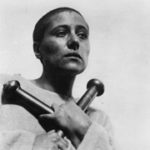
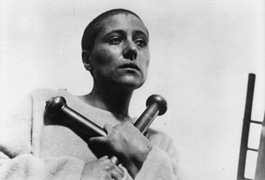
The last days of Jeanne d’Arc: interrogation, conviction, and her death at the stake. However, if one seeks a concise description, it’s less of an epic narrative (certainly not an action film) and more of a “radical montage film” from the late silent film era.
The theme of Passion itself is the central focus of the cinematic expression – references to Christ’s Passion are unmistakable.
La Passion de Jeanne d’Arc (1928) is an outstanding document of a time when film was still considered the art of moving images in the truest sense. Even here, the film’s images are enough to powerfully convey the hopeless struggle of a simple peasant girl against a phalanx of indoctrinated priests.
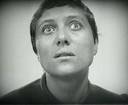
This is reflected in the expressive, simple face of Maria Renée Falconetti as well as the faces of her judges, with their brilliantly differentiated physiognomies, exaggerated but never overdone expressions; all of this penetrates the viewer’s mind through unrelenting close-ups for one and a quarter hours.
Music
New music for organ and voice, combining medieval themes with contemporary sounds.
For the Cologne Philharmonie and the Murnau Foundation, I developed a version for organ, choir, and soloist, which has been performed four times so far.
Concept of the Film Music:
Sound films have speech, music, and sound effects. In a silent film, however, music must take on not only its dramaturgical tasks but also compensate for the missing acoustic components. In sound films, long pauses in music are filled by other acoustic events. But in silent films, the musical interruption (unless intentionally used) creates an “acoustic hole”: the atmosphere is torn, and an unpleasant feeling of disillusionment sets in. The dilemma of a composer writing a score for an 80-minute silent film is obvious.
I decided to vary the “perspective” of the music, not only to structure dramaturgically related sequences but also not to simply paraphrase the plot. Often, I placed sounds that contrast with the obvious image content, creating a separate “acoustic layer of meaning.” For example, the sequence of Jeanne’s death by fire—representing an inner combustion—is musically portrayed as very calm, with an intimate sense of certainty and redemption, represented sonically by the use of the choral theme In Paradisum (“May the angels lead you to paradise…”). On the other hand, the subsequent peasant uprising—an outer combustion—escalates aggressively.
Dreyer’s film is neither pleasant nor easy to consume: it systematically destroys a certain type of unpleasant human being—an innocent peasant girl against dialectically trained, hostile clerics (the parallels to Christ’s Passion are unmistakable). The music cannot sound “pleasant” either: it expresses human suffering, pointing to the Passion. Jeanne’s death simultaneously marks the triumph of spirit over matter: simplicity triumphs over aggression, simplicity over complex mechanisms, harmonic relaxation over the build-up of all available sound parameters.
The uniqueness of the music lies in the combination of authentic and/or altered Gregorian chant melodies, all chosen with care. The processing of these pre-existing melodies goes beyond simply fitting a “liturgical music” or a “sacred garment” to the film; instead, it serves as a backdrop that can be “read” by the listener in several layers.
Most of the quotes are woven into the organ music without their original lyrics and rhythmically altered. In the first layer, the music can be perceived as loud or soft, dark or bright, pleasant or threatening, and thus already achieves the intended effect!
On further deeper levels, the quote can be deciphered and a connection might be made, such as: dark sound — threatening atmosphere — quote from Dies Irae (from the funeral liturgy) — Requiem sequence with themes of vengeance and retribution — terrifying vision — specific text quote: “You will destroy the world by fire…”
Dreyer’s perfectly naturalistic montage technique creates an almost spiritual imagery that only on a higher level forms a meaningful structure. The film itself, in its narrative structure, points to a claimed transcendence behind the fate of the saint.
The music reflects this by acknowledging the end of traditional harmony while being firmly rooted in late Gothic-liturgical music, thus taking both the avant-garde content of the film and the Protestant aspects of the fate of the heretic seriously.
Direction
Carl Theodor Dreyer (* February 3, 1889, Copenhagen, Denmark; † March 20, 1968, Copenhagen) was a Danish film director.
Dreyer began his career as a theater critic before entering the film industry in 1912 as a screenwriter. He worked for the Danish film production company Nordisk, for which he directed his first film The President (1919).
Inspired by David Wark Griffith’s Intolerance, Dreyer created his episodic film Leaves from the Book of Satan (1921). Prior to that, he directed The Pastor’s Wife (1920) in Sweden. In the early 1920s, Dreyer moved to Berlin to work with UFA, where he made the chamber play Michael (1924). By 1928, his silent film The Passion of Joan of Arc (produced in France) had earned him recognition as one of the most significant filmmakers, based on the original court records of Joan of Arc’s inquisitorial trial.
Among the numerous film adaptations of the Joan of Arc story, Dreyer’s 1928 French production stands out as a landmark.
Dreyer managed to coax the maximum natural expression from his actors, particularly Renée Falconetti as Joan, enhancing the film’s effect with striking close-ups, unusual camera movements, and perspectives.
The film captivates with its distinctive and at times extreme camera angles and many unusual close-ups. Dreyer pushed his lead actress to the brink of exhaustion to convincingly depict Joan’s inner torment.
The film is considered one of the most important French films of the 1920s, although Dreyer’s artistic tradition was more rooted in Scandinavian cinema.
Dreyer’s first sound film, Vampyr – The Dream of Allan Grey (1932), was made in Germany. It is now considered a classic of horror film, despite lacking explicit violence. It was a failure with contemporary audiences, as was his previous work. Dreyer returned to Denmark, and it wasn’t until 1943 that his next film, Day of Wrath, appeared, dealing with witch belief and persecution at the dawn of the modern era.
After 1946, Dreyer made several documentary films for the Danish government. With his last two works, Ordet (1955) and Gertrud (1964), based on a play by Hjalmar Söderberg, Dreyer once again created films of lasting artistic value. His focus on the essentials in Gertrud was not understood at the time of its premiere in 1964, but the particular modernity of this masterpiece became apparent only after his death.
Carl Theodor Dreyer is regarded today as one of the most important cinematic visionaries and stands alongside Fritz Lang and Friedrich Wilhelm Murnau as one of the most significant European directors of his time.
Films by C. Th. Dreyer
Selected films that Wilfried Kaets has performed live with music in concert:
-
1919 The President (Præsidenten)
-
1920 The Pastor’s Wife (Prästänkan)
-
1921 Leaves from the Book of Satan (Blade af Satans bog)
-
1922 The Marked Ones (De Gezeichneten)
-
1922 Once Upon a Time (Der var engang)
-
1924 Michael
-
1925 Thou Shalt Honor Thy Wife (Du skal ære din hustru)
-
1926 The Bride of Daalenhof (Glomdalsbruden)
-
1928 The Passion of Joan of Arc (La Passion de Jeanne d’Arc)